The Problem#
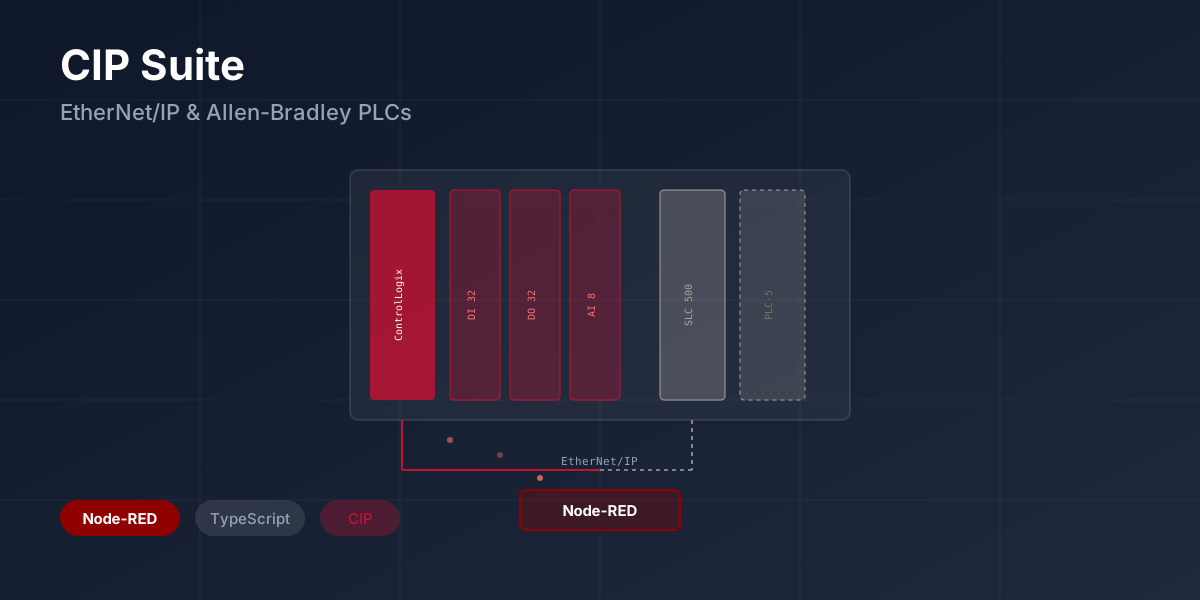
Allen-Bradley PLCs dominate North American manufacturing — but integrating them with modern edge and IoT platforms means dealing with the CIP protocol stack, legacy PCCC addressing for older PLCs, and a completely different programming model than Siemens or OPC-UA. Existing Node-RED solutions cover only basic tag reads, leaving out legacy hardware, raw CIP access, I/O scanning, and advanced objects like motion and energy.
The Solution#
A comprehensive Node-RED package for EtherNet/IP that covers the full range of Rockwell Automation hardware — from modern ControlLogix and CompactLogix to legacy SLC 500, MicroLogix, and PLC-5 — plus raw CIP access for any EtherNet/IP device.
Supported Hardware#
| Platform | Protocol | Notes |
|---|---|---|
| ControlLogix (L6x, L7x, L8x) | CIP Symbolic | Slot-based backplane routing |
| CompactLogix (L1x, L2x, L3x) | CIP Symbolic | Typically slot 0 |
| Micro800 (820/850/870) | CIP Symbolic | Enable Micro800 mode |
| SLC 500 | PCCC over CIP | File-based addressing |
| MicroLogix (1100/1400) | PCCC over CIP | File-based addressing |
| PLC-5 | PCCC over CIP | File-based addressing |
| Third-party CIP devices | CIP Raw | Any EtherNet/IP device |
Core CIP Nodes#
8 nodes for modern Logix controllers:
- cip-endpoint — Shared TCP session with auto-reconnect and multi-hop routing
- cip-read — Read tags with bit access, array elements, ranges, and batch operations
- cip-write — Write tags with atomic bit operations and partial UDT merging
- cip-browse — Tag discovery with glob/regex filtering and program-scoped tags
- cip-subscribe — Cyclic multi-tag scanning with deadband filtering
- cip-controller — Read identity, mode, faults; execute runtime commands
- cip-raw — Send raw CIP service requests with Multiple Service Packet support
- cip-discover — UDP broadcast for network device discovery
Legacy PCCC Nodes#
3 nodes for SLC 500, MicroLogix, and PLC-5:
- cip-pccc-endpoint — Raw TCP session with PCCC encapsulation
- cip-pccc-read — Read PCCC addresses (
N7:0,F8:0,B3:0/5,T4:0.ACC) - cip-pccc-write — Write with bit-level read-modify-write support
Advanced CIP Object Nodes#
8 nodes for specialized CIP objects:
- cip-io-scanner — Implicit I/O via ForwardOpen + UDP for cyclic exchange
- cip-security — TLS/DTLS status and security profiles (Class 0x5D)
- cip-sync — IEEE 1588 PTP time synchronization (Class 0x43)
- cip-motion — Motion Axis: jog, move, home, stop, enable/disable (Class 0x42)
- cip-energy — Power/energy monitoring and electrical measurements (Class 0x4F/0x4E)
- cip-file — Firmware upload/download with fragmented transfer (Class 0x37)
- cip-param — Device parameterization with discovery scan (Class 0x0F)
Tag Addressing#
CIP Symbolic (Logix)#
MyTag              → Simple tag
MyDint.5           → Bit access
MyArray[3]         → Array element
MyArray[0..9]      → Array range
Program:Main.Tag   → Program-scoped
PCCC (SLC/MLX/PLC-5)#
N7:0      → Integer       T4:0.ACC  → Timer accumulator
F8:5      → Float         C5:0.ACC  → Counter accumulator
B3:0/5    → Bit           O:0/3     → Output
S:1/5     → Status        I:1/0     → Input
Docker Simulation Environment#
Multi-profile PLC simulator for development and testing:
| Container | Description | Port |
|---|---|---|
| plc-clx | ControlLogix simulator | 44818 |
| plc-cplx | CompactLogix simulator | 44819 |
| plc-micro | Micro800 simulator | 44820 |
| plc-mlx | MicroLogix simulator (PCCC) | 44821 |
| plc-plc5 | PLC-5 simulator (PCCC) | 44822 |
| node-red | Node-RED with test flows | 11880 |
Reliability#
- Auto-reconnect with configurable intervals
- Backpressure protection — skips requests while one is in-flight
- Atomic bit operations via CIP Read-Modify-Write (0x4E)
- Connection metrics (response times, error counts, uptime)
- Admin HTTP endpoints for tag browsing and diagnostics