The Problem#
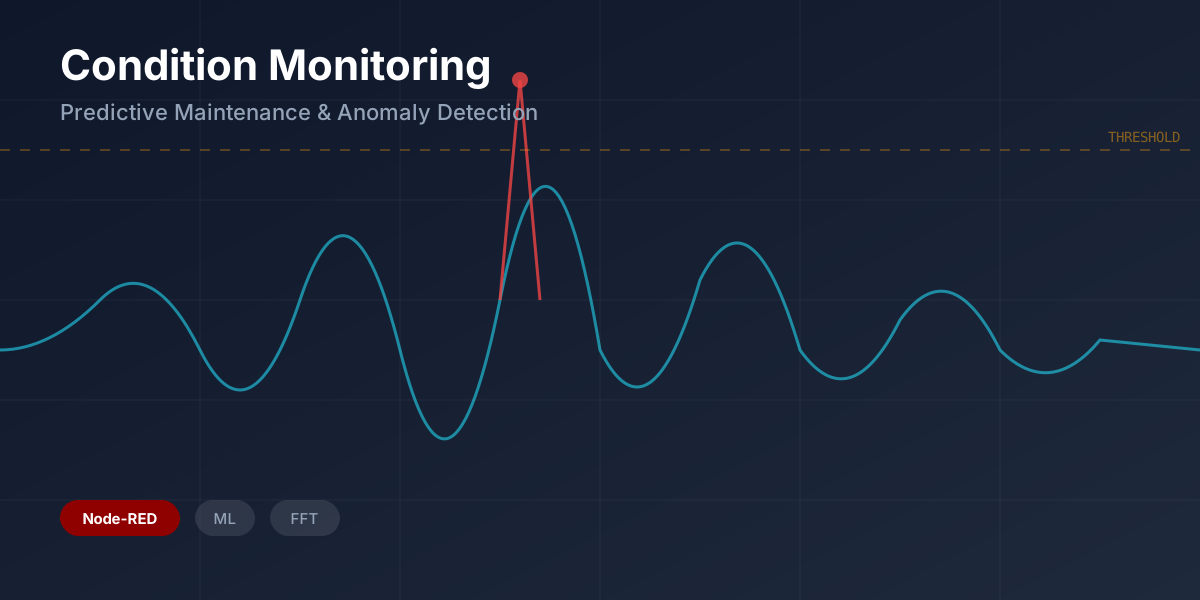
Unplanned machine downtime costs manufacturing companies thousands of euros per hour. Traditional maintenance approaches — either reactive (fix when broken) or calendar-based (replace after X months) — are either too late or too wasteful. Sensors generate massive amounts of data, but without the right tools, operators can’t act on it in time.
The Solution#
A Node-RED module that turns raw sensor data into actionable maintenance insights — directly on the factory floor, without cloud dependency. 9 specialized nodes cover the full predictive maintenance pipeline: from data ingestion and anomaly detection to ML inference and health scoring.
Architecture#
The suite is designed as a modular pipeline where each node handles one responsibility:
Sensors → Signal Analyzer → Anomaly Detector → Health Index → Dashboard/Alert
                ↓                   ↓
        Training Data          Trend Predictor
          Collector               (RUL)
Anomaly Detection#
10 statistical algorithms to catch deviations before they become failures:
| Algorithm | Best For |
|---|---|
| Z-Score | Normally distributed sensor data |
| IQR | Outlier detection with skewed distributions |
| CUSUM | Detecting small, gradual shifts |
| Isolation Forest | Unsupervised ML, no training labels needed |
| PCA | Multivariate anomaly detection across correlated sensors |
All detectors support hysteresis — preventing alarm floods from noisy signals oscillating near thresholds.
Signal Processing#
- FFT (Radix-4 Cooley-Tukey) for frequency analysis of vibration data
- Envelope detection for bearing fault diagnosis
- Cepstrum analysis for gearbox diagnostics
- ISO 10816-3 vibration severity classification (zones A-D)
- Butterworth filtering with zero-phase processing
Predictive Maintenance#
- Remaining Useful Life (RUL) — Weibull distribution modeling predicts when a component will likely fail
- Trend prediction — Linear regression and exponential smoothing forecast sensor trajectories
- Health Index — Multi-sensor aggregation with dynamic weighting produces a single 0-100 health score
ML Inference at the Edge#
Run trained models directly in Node-RED without cloud roundtrips:
- ONNX, TensorFlow.js, Keras, scikit-learn, TFLite
- Google Coral / Edge TPU hardware acceleration for real-time inference
- Persistent Python subprocess bridge for efficient repeated inference
- Built-in Training Data Collector exports labeled datasets to CSV/JSONL for model retraining
Quality#
- 135 unit tests covering all nodes and edge cases
- State persistence across Node-RED restarts
- Dynamic runtime configuration via message objects
- MIT licensed, production-ready